


It is time to redesign your website when it no longer supports your business objectives, gives visitors a poor experience or is held back by technical limitations that small fixes cannot solve. Age alone is not a reason: a five-year-old site that converts well and is easy to manage may only need targeted improvements.
The decision should come from evidence rather than taste: conversion rates, user behaviour, speed, search visibility and how hard the site is to update. This guide sets out the warning signs, the questions to ask and how to protect your SEO, drawing on our website redesign services for organisations across Europe.
In short: It’s time to redesign your website when it no longer supports your business objectives, delivers a poor user experience, generates insufficient conversions or suffers from significant technical limitations. Other warning signs include outdated branding, poor mobile performance and difficulty managing content. Before investing in a redesign, evaluate your website’s performance to determine whether targeted improvements or a complete rebuild are necessary.
7 signs it’s time to redesign your website
One sign on its own rarely justifies a full redesign. Two or three together, confirmed by data, usually do.
1. Your website looks outdated or no longer reflects your brand
Dated visuals, inconsistent colours and typography, or messaging that describes the company you were five years ago all undermine credibility, especially in premium or competitive markets.
A redesign often becomes necessary after a rebrand or a change in positioning, because the website is where most people meet the new brand first. If the problem is mainly visual, start by deciding whether you need a brand refresh or a full rebrand; the website then follows that decision. This is why we usually plan branding and visual identity and the website together.
2. Your website isn’t generating enough leads or conversions
When traffic holds steady but enquiries, bookings or sales fall, the problem is often the journey: unclear navigation, weak calls to action, long forms or key information buried three clicks deep.
Measure before you redesign. Look at conversion rate by page and device, form starts versus submissions, and where people leave. Session recordings and heatmaps show what the numbers cannot. For Dr. Alexander Cuno, a Geneva facial plastic surgeon, our UX/UI design work built clear paths to book a consultation on desktop and mobile as part of a brand refresh and website revamp.
3. Your website performs poorly on mobile devices
For many organisations, most visits now come from phones, and Google indexes the mobile version of a page first. A site that was simply shrunk to fit a small screen, with tiny tap targets or menus that hide key pages, loses both users and visibility.
Judge this with real data: compare mobile and desktop conversion rates in your analytics, check mobile usability and Core Web Vitals in Google Search Console, and watch a few people complete a task on their own phones. Accessibility belongs in the same review.

4. Your website is slow or has technical performance issues
Slow pages cost attention and conversions. Common causes include heavy scripts and plugins, unoptimised images, poor hosting, outdated infrastructure and accumulated technical errors. Google’s Core Web Vitals give useful benchmarks: a good Largest Contentful Paint is 2.5 seconds or less.
Not every speed problem needs a redesign. Image compression, caching, removing unused plugins or moving to better hosting can fix a lot. A redesign becomes the better option when the theme, page builder or architecture itself is the cause.
5. Your website is difficult to update or maintain
If your marketing team needs a developer to publish a landing page or change a menu, the website is slowing the business down. Rigid templates, an unsupported CMS version and fragile dependencies also make every update a risk.
A good content management system lets your team work independently within clear limits. For LTTD Consulting, we built the site on WordPress with a flexible CMS configuration and custom templates, so the team can update content and publish job offers themselves.
6. Your website no longer supports your business objectives
Entering new markets, launching services, targeting a different audience, adding functionality such as bookings or moving into e-commerce can all outgrow a structure designed for an earlier strategy.
When the sitemap no longer matches how you sell, adding pages to the old structure usually makes things worse. The website has to evolve with the business.
7. Your website has structural SEO problems
Poor site architecture, duplicate content, indexing issues and a CMS that cannot handle redirects or structured data properly all limit organic growth.
Declining organic traffic does not automatically justify a redesign. It can come from algorithm updates, new competitors, lost backlinks, seasonality or a tracking error. Investigate the cause first; redesigning without a diagnosis can make an SEO problem worse.
How often should you redesign your website?
There is no universal schedule. Some websites stay effective for many years with continuous improvement, while others need major changes within two years because the business, the brand or the technology has moved on.
The pace depends on business growth, brand evolution, technology changes, user expectations, conversion performance and the technical debt that builds up. Rather than scheduling a redesign every few years, audit the website regularly and improve it in small steps.
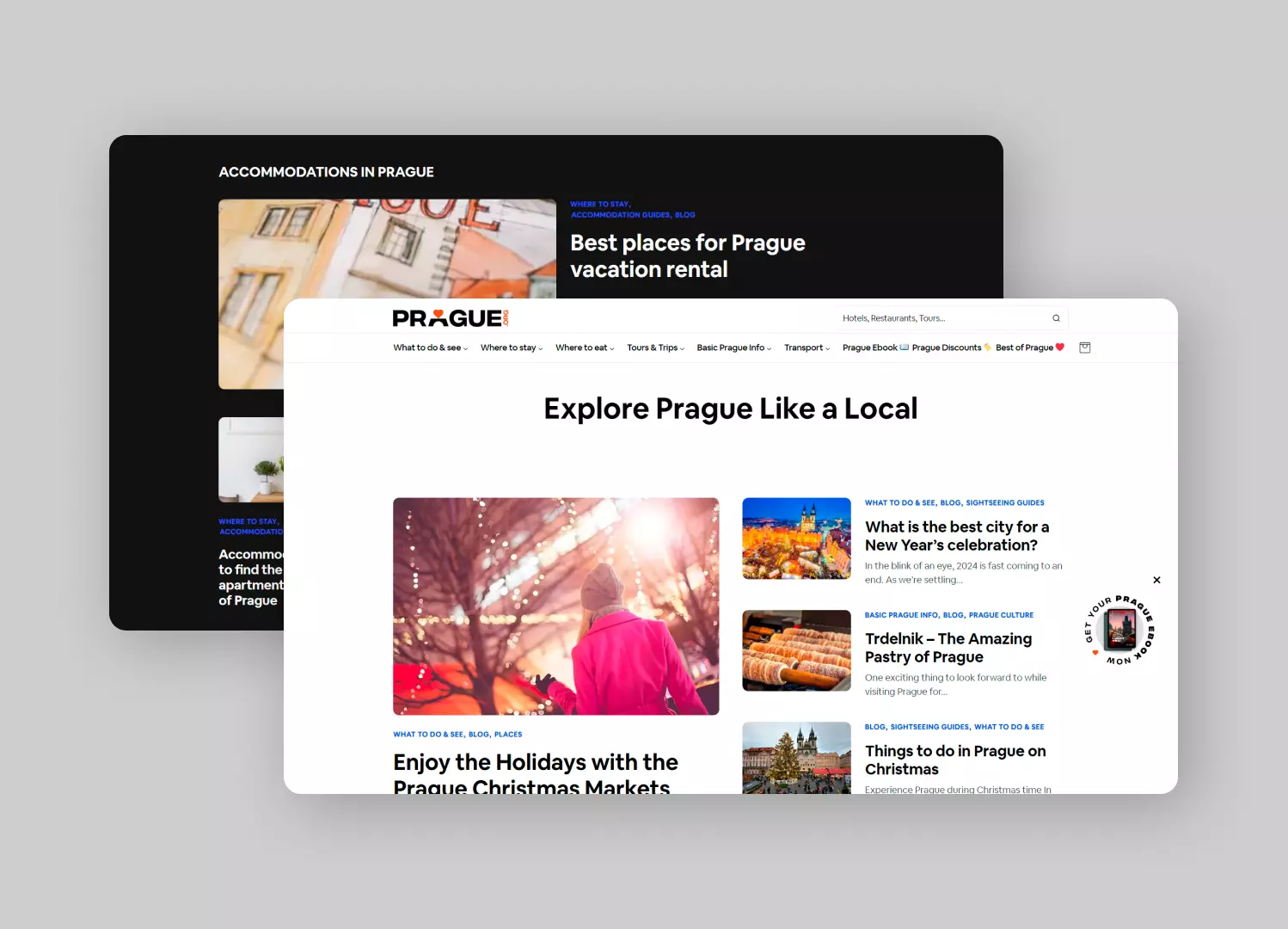
Prague.org shows the approach. After a complete UX/UI revamp, the travel guide has been measured, analysed and refined continuously, and alongside the digital strategy work, traffic grew from 300 to 9,000 monthly visits in six months.
Website refresh vs redesign vs rebuild: Which do you need?
| Approach | What changes | Typical trigger |
|---|---|---|
| Website refresh | Visual, content or usability improvements without major structural changes | Outdated colours and typography, a lighter brand update |
| Website redesign | User experience, navigation, visual design and page structure | Poor navigation and conversion paths, a new positioning |
| Website rebuild | Substantial parts of the technology, CMS or architecture | Unsupported CMS, extensive technical limitations, new functionality |
The choice depends on where the problem sits: in the surface, the user journeys or the platform itself. A professional audit is the most reliable way to decide, because it separates cosmetic issues from structural ones. Our guide to website redesign costs shows how budgets differ between these three approaches, and our guide to WordPress website development costs covers the budget for a new WordPress build.
When is it worth investing in a website redesign?
When is it time to invest in a website redesign? When the expected gain in qualified leads, online sales, organic visibility, engagement or operational efficiency clearly outweighs the cost, including the maintenance you would otherwise keep paying on an ageing platform.
Define measurable objectives before you approve the budget. A simple illustration: a site with 5,000 monthly visitors converting at 1% produces 50 enquiries a month. If a better journey lifted conversion to 1.5%, the same traffic would produce 75. This is an illustration, not a forecast: real results depend on traffic quality, user behaviour and implementation.
What questions should you ask before redesigning your website?
These eight questions turn a vague wish for “a new website” into clear requirements:
- What problems are we trying to solve?
- Which pages currently generate the most traffic and conversions?
- What do users struggle with on our existing website?
- Does our website reflect our current brand and positioning?
- Which features and content should we retain?
- What technical limitations need to be addressed?
- What is our budget and expected timeline?
- How will we measure the success of the redesign?
Clear answers prevent unnecessary development work and give every agency the same basis for a proposal.
How do you protect SEO when redesigning a website?
A redesign can cost you organic visibility if URLs, content or technical settings change without a plan. A well-prepared SEO migration keeps what already works.
Audit your existing SEO performance
Before changing anything, record organic traffic, rankings for important keywords, top landing pages, backlinks, indexed URLs and current technical issues. This baseline tells you which pages must be protected and lets you measure the result after launch.
Plan URL changes and redirects
Keep valuable URLs wherever possible. When a URL must change, map each old page to the most relevant new page and set up permanent (301) redirects. Never redirect everything to the homepage.

For Esprit Calme, a yoga retreat website, we revamped the WordPress site while keeping all existing URLs and content, so the migration protected its SEO positioning and recent bookings. See the Esprit Calme project.
Preserve valuable content and metadata
Do not remove or rewrite high-performing content without checking what it contributes to search. Carry over page titles, meta descriptions, headings, internal links and structured data, or improve them deliberately.
Test the redesigned website before launch
On the staging site, check crawlability, indexing directives such as noindex tags, redirects, canonical tags, mobile usability, performance, analytics and conversion tracking. A forgotten noindex tag is one of the most common and costly launch errors.
Monitor SEO performance after launch
Watch indexing, traffic, rankings and crawl errors closely for the first weeks. Even well-managed migrations can see temporary fluctuations; what matters is spotting real problems early. Our technical SEO team can support the audit, migration and follow-up.
How do you plan a successful website redesign?
A redesign runs best as one coordinated project rather than a sequence of handovers:
- Audit the existing website.
- Define business objectives and KPIs.
- Analyse users and competitors.
- Plan information architecture and content.
- Design the new user experience.
- Develop and test the website.
- Prepare SEO migration.
- Launch and monitor performance.
Strategy, UX/UI, development and SEO need to work together from the first step. At Morpheon, a website revamp moves through scope and objectives, a strategic roadmap, UX/UI design, then development and integration, with SEO built into the structure from day one.
Frequently asked questions
How do I know if my website needs a redesign?
Look for several signs together: falling conversions, poor mobile performance, slow pages, outdated branding, content that is hard to update or a structure that no longer fits your business. Confirm them with analytics, Search Console and user testing before deciding.
Should I redesign my website if traffic is declining?
Not before you know why. Declining traffic can come from SEO, technical, content or market factors, including algorithm updates or new competitors. Investigate first; a redesign is only the answer if the cause is structural.
Is it better to redesign or rebuild a website?
It depends on the technical condition of the current site and your requirements. If the platform is sound but the experience is weak, redesign it. If the CMS is unsupported or cannot support the functionality you need, rebuild it, and redesign at the same time.
How much does a website redesign cost?
It depends on scope: a visual refresh, a redesign of a small business site and a complex rebuild sit in very different budget ranges. Our guide to how much a website redesign costs sets out realistic figures and the factors behind them.
Can redesigning a website hurt SEO?
Yes, if the migration is poorly managed. Changed URLs without redirects, deleted content, lost metadata or indexing errors can all reduce organic traffic. A planned SEO migration with a baseline audit, redirect map, pre-launch testing and monitoring keeps that risk low.
Is your website holding your business back?
A website redesign should solve real business problems, not simply change how your website looks. At Morpheon, we combine UX/UI design, development and performance optimisation to create websites that support your business objectives.
